Home Blog Page 306

TEST RIDE: Can-Am Spyder Roadster

0

Dirt Trax Television Co-Hosts Mark and Luke Lester review Can-Am’s Spyder and talk about how it differs from your average sport touring motorcycle.

Check out Dirt Trax Television’s YouTube page for more Test Rides at YouTube.com/dirttraxtv.

Click here to purchase you own DVD set of the Dirt Trax Television season!

TEST RIDE: Polaris RZR Sport

0

Luke displays the awesome power of Polaris’ RZR Sport as he puts both dirt and air under all 4 tires.

Check out Dirt Trax Television’s YouTube page for more Test Rides at YouTube.com/dirttraxtv.

Click here to purchase you own DVD set of the Dirt Trax Television season!

Rhino Tire Gel Puncture Coating

The staff of All-Terrain Vehicle Magazine does much of its testing in a geographic area strewn with rocks, roots, stumps and some of the gnarliest terrain you can imagine. We get flats all the time and we hate it when it happens in the middle of a great day of riding.

No doubt you’ve experienced the frustration of tire failure and have wondered why someone hasn’t come up with a bulletproof way to prevent tires from getting holes in them.

We think we may have found the answer. We’ve been testing Rhino Tire Gel for a while now and haven’t had a flat. To bring more perspective to this story we decided we had better try harder.

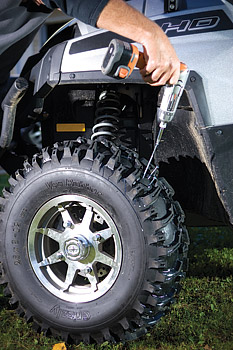
As you can see, the screws inserted into the Rhino coated tire haven’t had any effect on the tire’s ability to remain inflated. What you can’t see is when the screws were extracted the semi-solid but pliable Rhino coating actually moved into the hole left by the screws. Amazingly, the tire didn’t go flat and hasn’t lost a pound of air pressure since this test.

Our first exposure to Rhino Tire Gel left us with some questions. Specifically, the issue of sidewall pinches, something we get more often than tread punctures.

Initially, the crew at Rhino were applying the coating only to the inner side of the tread surface – completely adequate for on-road vehicles like cars, trucks and motorcycles. However, soft sidewall, low pressure ATV skins need protection on the non-tread surface of the sidewall, too. Rhino has responded and is now applying the coating to sidewalls on ATV tires.

Don’t write this product off as just “more sloppy guck inside a tire”. The Rhino coating is applied evenly using a techy machine that actually sprays the coating into the tire while it’s rotating so it won’t affect wheel balance.

The coating dries to a semi-firm state that’s solid enough to stay in place but soft enough to instantly fill any holes coming from the tire’s exterior surface. The stuff feels kinda gummy but doesn’t stick to your fingers when touched. Once it’s sprayed in place and your tire is mounted, you’ll likely never see it again, and that’s good.

Our initial reaction to this innovative technology is overwhelmingly positive. We think Rhino Gel should be used in every ATV tire right from the factory. There’s no downside to having your meats coated with Rhino Tire Gel – it’s a win-win deal and we recommend it.

Go to RhinoTire.com and check out this product.

KYMCO Rider Takes First at Yadkin Valley Stomp

Kyle Golding, a 16-year-old SC native, pulled out a first place finish riding a KYMCO Maxxer 375 in the Yadkin Valley Stomp GNCC Race held May 8 – 9, 2010.

This win follows two back-to-back third place finishes in two previous GNCC races and puts him in fourth place in his class overall.

Golding’s rise to fourth place in the 4×4 Lites class is even more impressive when you realize that he did not even participate in the first three races of the series.

The Yadkin Valley Stomp is held in Yadkinville, NC, which is wine country. The name of this event comes from its roots in wine – you stomp on the grapes to make wine.

This track is very tight and is very unforgiving. Racers need a good start and cannot make any mistakes to do well here. The track features a large water section and a large tunnel for the riders, making it a fun venue for spectators as well.

However, this track worked well for Golding and his break-through race. He won with a last-lap pass, ending the 4×4 Lites points leader, Kevin Trantham’s five-race winning streak.

Al Golding, KYMCO USA’s Accessories Manager and Kyle’s father was on site in Yadkinville to provide support and cheer his son on. “Kyle has been riding ATVs since he was eight years old and has been racing for five years. The whole family rides, but Kyle really has a special talent for the sport and he loves the mud!”

The Maxxer 375 is a good fit for Golding in the 4×4 Lites class, which is made up of 201-560cc ATVs. While it is not the most powerful in the class, its performance and agility give it the edge necessary to be a winner.

Designed for both sport-performance on the trail and rugged, comfortable utility use, the Maxxer 375 offers ATV buyers the best of both worlds. With the Maxxer’s shift on-the-fly 2WD and 4WD and a class-leading sport-tuned independent rear suspension (IRS), KYMCO has created a versatile ATV that will give years of trouble-free service and exceptional value.

The Maxxer 375 also features KYMCO’s proven CVT transmission, low-maintenance shaft-final-drive, single cylinder DOHC four-stroke engine with electric start, sure stopping hydraulic disc brakes all around, aluminum alloy wheels and distinctive new body styling. It is backed by KYMCO’s standard one-year factory warranty.

About KYMCO USA – KYMCO’s roots in the motorsports industry go back to its founding in 1963 as the Kwang Yang Motor Company, Ltd., with headquarters in Taiwan. Long a leader in quality, fuel economy, and versatility, today KYMCO manufactures motor scooters, motorcycles, and ATVs at five plants in Asia, including the main facility in the city of Kaohsiung.

KYMCO is the largest scooter manufacturer in Taiwan and currently exports to 88 countries worldwide. All KYMCO plants use the latest technology for the engineering and production of reliable engine, chassis, and other components. Since 2004, KYMCO has been officially accredited for ISO-9001 quality in manufacturing. KYMCO is committed to maximum customer satisfaction and constant innovation, making use of the most advanced CAD/CAE tools to bring superior engineering and design to their products.

The company’s partner in the United States is KYMCO USA with headquarters, marketing and distribution centered in Spartanburg, South Carolina. KYMCO USA is dedicated to building the brand’s reputation and market share through superior value, frequent new product introductions, strategic industry partnerships, and excellence in dealer network support. KYMCO USA has a reputation and expertise gained through over 30 years in the U.S. motorsports industry.

HIGH RANGE: Friend or Foe

In many jurisdictions, trails built strictly for motorized use are a shared asset. However, the other side of the coin is that in some places we are legally bound to share some of our trails with non-motorized users.

Shared use trails where motorized and non-motorized users come together can be a source of great angst. Virtually 100 percent of the time it’s the motorized users who pay to build and maintain these “multi-use” routes.

Often, non-motorized users have been allowed access to these trails as a result of political wrangling. It’s like we’ve been held hostage with our own gun. If we let non-motorized users on our trails we can keep our trails? As much as I resent this reality, we have little choice but to deal with hikers and bikers using the trails we’ve developed and maintained at our expense.

This idea of shared use is what politicians and bureaucrats want from the motorized community. The success of multi-use trails lies mainly in understanding and managing how motorized and non-motorized users behave in close proximity.

If hikers walk 5-wide on rail-grade trails while displaying intolerance in the face of approaching motorized users there will be a confrontation.

If motorized users wick-up the throttle when meeting hikers and bikers, leaving them gasping in a cloud of dust, there will be problems.

As is almost always the case, this issue will ultimately come down to continued tolerance on the part of the motorized fraternity. You can be sure a pair of hikers complaining to local authorities about a motorized trail user will get way more traction than an ATVer complaining about renegade hikers not moving out of the way on a trail. It’s just the way it is.

So get behind our motorized allies and then muster as much tolerance as you can for the non-motorized users we have to share our trails with. Take one for the team!

Rockstar Makita Suzuki Dominates Steel City

Josh Creamer now leads the AMA ATV MX series with 219 points, three points ahead of Wimmer, who held the lead going into Steel City. Both Wimmer and Creamer have finished on the podium at every round so far in 2010. The QuadRacer R450 has been amazing this season, with the power and handling to keep the Rockstar Makita Suzuki team up front at every race.

Rockstar Makita Suzuki’s Josh Creamer and Dustin Wimmer dominated the AMA ATV MX series on Sunday, making it the fifth race in a row in which both racers were on the podium. Creamer took the overall victory after impressive 1-1 moto finishes, overtaking the series point lead. Reigning 2009 AMA ATV MX Champion Dustin Wimmer rode to a second-place overall finish after racing his way to 3-2 moto finishes.

Creamer held the series lead going into the last race, Round 4, and wanted to take it back from his teammate Wimmer at Steel City. Creamer did just that by winning both motos and taking the overall. “It’s going to be a good battle to the end of the season between Dustin and I,” Creamer said, “as long as we can both stay healthy and keep the bad luck away.” Creamer’s first moto start was not as good as he had wanted, coming out of the first turn in about 13th place. Creamer and his R450 didnÂ’t give up though, knowing they had plenty of time to make up ground and get to the front of the pack, which is exactly what they did. Creamer took his Rockstar Makita Suzuki R450 around 12 racers by the end of the first moto, claiming an amazing victory.

Wimmer started the race much the same as Creamer due to a bottleneck at the start that put him in 12th place. Wimmer worked his way through the pack to finish third in the first moto. Near the finish line on the last lap, Wimmer was hit with a large rock that was roosted up by another racer. The rock hit him in the kneecap but Wimmer was able to overtake the racer and finish in third. “It was painful,” Wimmer said. “It was more like a boulder than a big rock, and it caught right on my kneecap. It’s a little swollen and it’ll be a little sore for a few days, but it didn’t keep me from doing well in the second moto and it wonÂ’t keep me from getting ready for the next race.”

The second moto start was a different story for Creamer. He came out of the gate in third place and quickly moved into second. The power of his QuadRacer R450 was no match for the other quads on the track and he soon moved his way into first and held on through the checkered flag. “My Rockstar Makita Suzuki was working great this weekend, and the Yoshimura motor was working well around the track and really pulled up the hills,” Creamer said. “It feels good to be back in the lead. I was leading heading into the last round and lost it there, but at least we got it back now. Hopefully we can keep it for when it counts – at the end of the season.”

Wimmer’s second moto start wasn’t as good as he had hoped, but in true champion fashion, was able to work his way around other racers and finish second behind his teammate.

Creamer is now leading the series with 219 points, three points ahead of Wimmer. Both of the Rockstar Makita Suzuki racers have finished on the podium at every round so far this year and have demonstrated that the Suzuki QuadRacer R450 is a true competitor. Round 6 of the AMA ATV MX series will take place on June 12-13 at Spring Creek in Millville, Minnesota.

TEST RIDE: Arctic Cat Prowler XTZ

0

Luke Lester hits the trails on Arctic Cat’s 2009 Prowler XTZ.

Check out Dirt Trax Television’s YouTube page for more Test Rides at YouTube.com/dirttraxtv.

Click here to purchase you own DVD set of the Dirt Trax Television season!

REVIEW: Arctic Cat Prowler 1000 XTZ

Snug Up Those Belts And Hang On!

If you threw a stick of TNT into a garbage can, slammed the lid on, sat down and held on tight, the upward accelerative force applied to your body from the explosion would be almost, but not quite as strong, as the forward force experienced when tramping the new Prowler XTZ 1000’s accelerator to the floor. By the way, never sit on a live stick of TNT without wearing a helmet.

What we’re talking about here is the two time All-Terrain Vehicle Magazine Best-in-Class Award winning Arctic Cat Prowler platform injected with the largest, most powerful mill ever seen in a SxS vehicle.

Take note, the Arctic Cat Thundercat’s 950cc V-twin lurks next to your right knee. The original Prowler platform powered by both 550 and 650 H1 carbureted “hemi” engines has been near and dear to our hearts.

In many ways, the Prowler is similar in layout to the legendary Yamaha Rhino. Its engine is located between the front seats, providing a slightly sportier look and feel than a Ranger XP. However, it’s important to understand its overall size is somewhat larger than a Rhino.

The frontal area of the Prowler is more Ranger-sized and the dump box is “Big Gulp” caliber, offering the highest sides in the biz. The Prowler’s double lined, molded plastic dump box is top-of-the-class for its precision finish and slick operation. The sides are high enough to contain messy loads and the tailgate is a tight fitting, consistent functioning piece with a one hand, truck style release.

Interior accoutrements are pleasing and mirror the classy level of trim in all Prowler models. The floor is an easy-to-clean and relatively flat plastic piece while the dash contains nice storage bins, a glove box and a multi-function gauge cluster identical to Arctic Cat’s Sport Utility ATVs.

Switch-gear for lighting and 4×4 activation is center mounted on the dash and falls readily to hand from either side. The steering wheel is a contentious item for most of our testers as it doesn’t tilt or telescope out of the way, interfering with entry and exit.

If you’ve got a two-cheeseburger gut, you’ll find the wheel downright intrusive. Seating is comfortable and both seats remove easily to provide access to the engine after removing the one-piece molded cover. We’ll make it clear from the outset, you canÂ’t haul three in a Prowler, period.

The Prowler has a stout and functional roll cage with a high mounted brake light. Combination shoulder and lap belts are a great inclusion and must be used to ensure both occupants stay put in this high performance vehicle. Actually, we felt uncomfortable at any speed in the XTZ without belts on.

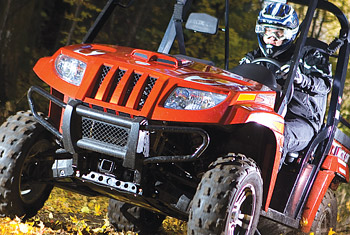
The XTZ 1000 adds some pretty sweet stuff to the Prowler platform. Ryde FX take-apart aluminum body gas shocks hang on all four corners. The XTZ gets nifty box rails, rock crusher bars on the running boards and a functional front brush guard.

A fiery orange mist paint job and faux hood scoop are nice touches and grab attention everywhere you go. The V-twin reactor buried in the frame emits a deep and ominous melody capable of sending mothers and small children searching for cover. Lastly, the XTZ sports four sweet looking cast aluminum wheels shorn with gnarly rubber.

Obviously, Arctic Cat is targeting the performance buyer with the XTZ 1000 and even though their path is identical to both Kawasaki’s Teryx “S” and YamahaÂ’s Rhino SE, all three of these hot-rodded sport-more-than-utility vehicles have one issue keeping them from ultimate head-on comparos to the RZR “S”.

If you park the XTZ next to the RZR “S” you can easily identify the RZR’s advantage. The Prowler’s engine placement is probably as much as 6-inches higher than the RZR’s. This single issue makes a tangible difference in the handling traits of the two vehicles. Simply put, the RZR can corner faster and flatter than any utility based sport SxS.

Now that we have that out of the way, we can talk about the XTZ’s handling. Clearly, all Prowlers display even, linear turn-in and hold a steady line in the woods or on fire roads at speed. The suspension package Arctic Cat massaged for the XTZ continues the tradition of generous wheel travel and, as a result of a standard rear anti-sway bar, nice side-to-side balance in both powerslides and on off-camber tight trails.

This vehicle is stupid fast. As if its 75-mph top speed alone wasn’t formidable enough, getting there is cannon-like. This creates the deliberate need for pilots to not be just judicious but really careful with their right foot.

So abrupt is the power delivery from this 75hp V-twin, EFI, 950cc monster, we actually had to practice throttle application to achieve less than jerky response at both engagement and mid-throttle. Frankly, we were never able to sort out the engagement drill with the XTZ. This one area of operation, specifically throttle calibration is, in our opinion, not acceptable for the average consumer.

It simply is easier to just slam the throttle down and not bother feathering it. It’s that abrupt. We think Arctic Cat should revisit the throttle linkage and develop something less touchy in an effort to produce more linear action. Having said that, no one who drove the XTZ came away anything but impressed – very impressed – with the way the vehicle pulls.

If you’re a rancher, hunter, fisherman or weekend family ATVer looking for a UTV to compliment your fleet, we would caution you to ask yourself if you need this much bare-chested aggression and unadulterated power. The garden variety SE Prowler 650 is a superb UTV that performs at or near the top of this segment and might be a better choice.

The XTZ is an outperforming, targeted-for-competition vehicle capable of intimidating all but the very experienced. Don’t get us wrong, we love this thing. However, we don’t use it for hauling sandwiches to trail-side picnics.

Arctic Cat has a corporate edict it holds mostly true to in every business it participates in: “Always occupy the highest performance segment of the sport you build product for”. For readers unfamiliar with Arctic Cat snowmobiles, last year the company introduced, in response to a competitive snowmobile producing about 150hp, a turbocharged, intercooled 175hp model to effectively slam the door shut on the “who is fastest question”.

If you lean to owning the biggest, baddest and fastest, there’s simply no other place for you to go but straight to your Arctic Cat store and sign up for the most radically powerful SxS available… the Prowler XTZ 1000.

Also see…

TEST RIDE: Arctic Cat Prowler XTZ

The Importance of Oil Changes

0

I received the following question in my inbox earlier this week after we posted last season’s segment on changing the oil in a Can-Am DS 450 to our You Tube page.

Maxomath asked, “Is it okay if I keep the oil filter a bit longer in my DS450, instead of always changing it after a complete oil change? How frequently should I change my oil in a given season?”

Great question. If this is your first oil change on your DS 450 you absolutely 100% need to change that filter. The break in period of the engine along with the possibility of leftover material remaining in the engine from production makes the initial filter change very important.

The thing about 4-stroke high performance motors is that they produce huge torque and truly require consistent oil and filter changes in order to stay healthy and avoid costly top-end rebuilds.

You may stretch your oil changes on your car a bit past the 5000 kilometer mark, but your DS will need to have the filter and oil changed regularly if you want it to perform at its peak efficiency. Keep in mind those few extra dollars you’ll shell out for a filter at each oil change will increase the life of your engine and deliver more hours of enjoyment out of the shop.

Refer to your owners manual for the manufacturer’s recommended frequency for changing the oil and filter and stick to that schedule. You’ll be happy you did and your ATV will thank you with many enjoyable hours on the track.

Watch this segment here…

Changing The Oil On A Can-Am DS 450

0

AJ Lester reviews how to change the oil on a DS 450. An entry level project that will keep your ATV healthy.

Check out Dirt Trax Television’s YouTube page for more Test Rides at YouTube.com/dirttraxtv.

Click here to purchase you own DVD set of the Dirt Trax Television season!