Johnson Valley, California, is a brutal proving ground for King of the Hammers: wide-open desert that drops into signal-killing rock canyons. Cell service is essentially nonexistent, and when something breaks deep in the rocks, “good luck” can be more than a saying—it can be your rescue plan.
For years, teams leaned on VHF/UHF radios, but the desert often wins: fading coverage, constant static, and drivers shouting into mics. Satellite phone systems helped, but the buy-in and monthly costs put them out of reach for many small-to-medium teams.
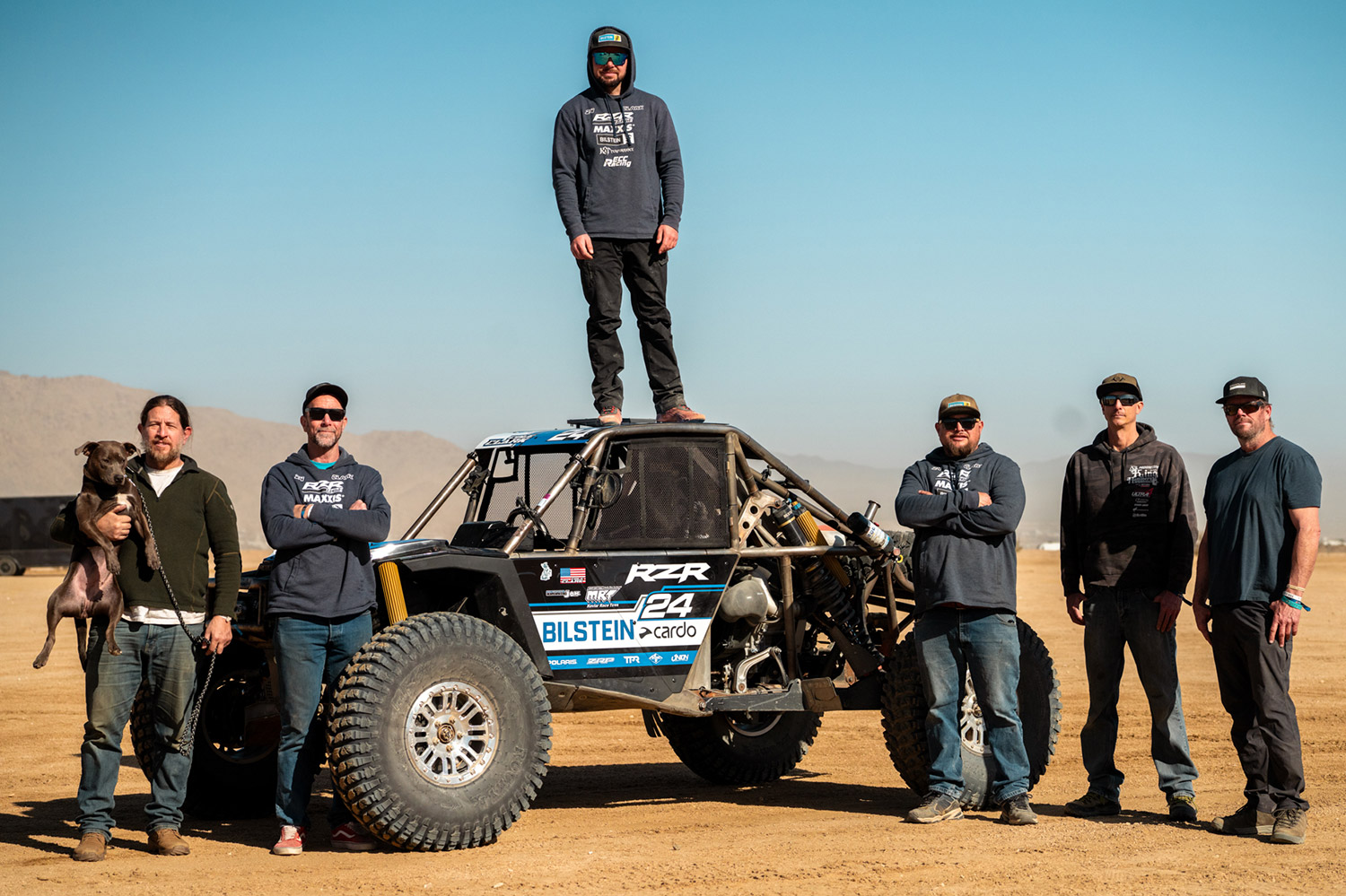
In 2026, two KOH teams—Cole Clark (24 Racing) and Dustin Robbins (Team All Things UTV)—ditched conventional race radios for a hybrid setup: Cardo helmet communicators paired with Starlink internet. The result was clear, long-range voice comms at a fraction of traditional race-radio cost.
Clark doesn’t mince words about legacy gear: “They almost never work. You end up having this giant tower in the pit… big heavy 12-volt battery… and it still doesn’t work.”
That’s starting to change.
INTEGRATING THE TECH
The idea is simple: use reliable consumer tech to build race-ready communications. Clark, running his ninth KOH in 2026, found that pit towers, heavy batteries, and tuning still didn’t deliver consistent coverage.
Clark built the system around modularity: a magnet-mounted Starlink dish he can move from his pre-runner to his Polaris Pro R in minutes. He estimates the setup at under $1,000 versus roughly $3,000 for a high-end, hard-mounted radio system. “It’s in and out, done… You spend more time having fun than working on your stuff,” he says.
Robbins took a more permanent route. Racing a CT Race Works-built Can-Am Maverick R X RC, he roof-mounted a Starlink Mini and wired it into 12-volt power, using Cardo wireless units as the in-helmet backbone. The payoff: communication “with anyone in the country with non-stop availability,” Robbins says.
SYSTEM OUTLINE: THE DIGITAL CHAIN
Both teams followed the same basic signal path:
- Inside the helmets (Cardo DMC): Packtalk Edge ORV units created an always-on line between driver and co-driver—no wires, no buttons.
- The bridge (Zello): A vehicle-mounted smartphone ran Zello, sending voice over the internet like a long-range radio.
- The connection (Starlink): The phone connected by Wi Fi to Starlink for coverage across Johnson Valley—even without line-of-sight to the pits.
- The trigger (push-to-talk): Drivers used Bluetooth PTT buttons—Clark an ASUS button paired to his phone; Robbins a steering-wheel-mounted switch.
REAL-WORLD PERFORMANCE
On race day, the difference was immediate. Clark’s father, Khan, describes the old system as “screaming.” Now, he says, the pits can hear problems clearly—enough to stage the right parts before the car arrives and turn a frantic stop into a targeted repair.
For Robbins and navigator Ben, Cardo’s noise canceling let them talk at normal volume. “I can keep my heart rate down,” Robbins says, turning the cockpit from chaos into “peace and quiet.”
The biggest practical win may be wireless freedom. In rock crawling, navigators often jump out to spot or winch; with wired helmets, comms die the moment you unplug. With this setup, a navigator can step out and still talk to the driver—up to about a mile away.
Clark teammate Mark Welch saw the surprise firsthand. While winching, Welch and Clark coordinated from outside the vehicle—calmly, and without yelling. Spectators couldn’t believe they were “talk[ing] to each other in your helmets.”
KOH 2026 proved the concept in the harshest conditions, with both teams earning top-five finishes. For off-road racing, Cardo-led helmet comms paired with satellite internet may be the new baseline—advanced technology helping conquer the most primitive terrain.
Sometimes, the best way to beat the rocks is to go through the sky.