Home Blog Page 164

John Deere Gator XUV 825i

0

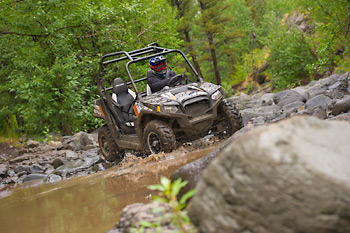
Until we had some seat time on the Gator 825i we had no idea a utility side-x-side could be such a pleasure to operate. In fact, this alone puts the 825i at the very top of our list of fave work UTVs.

The key to this smoothness is John Deere’s use of a Chinese developed and manufactured 812cc Cheri DOHC EFI triple. This 50-hp inline three is so smooth it reminds us of BMW’s famous inline six. It simply hums a happy little theme at low RPM and even when wound out it exudes velvety, creamy smoothness.

It’s hard to describe how pleasant it is to operate a vehicle with no vibrations coming through the seat, steering wheel or floorboards. In fact, the whole Gator 825i is so integrated and solid feeling it behaves more like a little truck than a side-x-side.

In typical John Deere style, the engineering team has thrown a series of curve balls across the plate and when they’re combined, they add up to an absolute win. You only have to stand back and squint at this Gator to notice its shape is different than most of its competitors.

There’s a gaping hole in the front where a windshield could fit between the roll cage and the dashboard and the odd-shaped, two-tiered doors look different than anything else. The front hoodline looks low – lower than the cargo bed further back. When you sit in the driver’s seat the view is, uh, panoramic, to say the least. You almost feel like you could fall forward over the hood if you weren’t belted in.

Instead of these differences making you feel uncomfortable, they add up to a great riding position that provides an unobstructed view of the trail right up to the headlights.

The doors could have been designed by Bentley and wouldn’t have been any more solid. They snap shut with a nice “thunk” and stay latched on the first try… always.

Even though you’re perched like someone sitting in a kitchen chair, there’s ample legroom and the controls are easy to reach for a wide variety of body shapes.

Maybe JD learned something about ergonomics from building all those tractors, dozers and combines people sit in all day.

Here’s something else smooth on this Gator. The dump box is hydraulically operated!

There’s plenty of capacity in that bed and it’s built like the USS Missouri, but who cares, it just operates so smoothly, I want it.

The Gator’s 4WD system engages without fanfare and can just be left in AWD if you don’t feel compelled to use 2WD. This is a no-brainer, user-friendly system that works (smoothly) even when you aren’t aware you’re using it.

When you need diff-lock, just flip the lever and it engages – smoothly. Same when you want to go from high to low range.

Suspension is double A-arm front and rear with a swaybar out back. Shocks are twin tube but this Gator has one of the nicest performing suspensions, front and back, of anything we’ve ridden and that includes some SxSs with real pricey gas shocks.

There’s eight inches travel up front and nine at the rear and no damping adjustment, just coil spring preload. It’s enough.

You can drive this vehicle over some pretty gnarly terrain at either low or high speed and you’ll be pleasantly surprised how well it performs. No harshness or jolts, it rarely bottoms out (in fact, it hasn’t yet) and remains far more compliant than you’d expect from a utility-targeted vehicle.

Brake action from four dual piston hydraulic discs is very buttery and predictable. We had Maxxis Bighorns on our press unit and those are good tires for the area we ride – plenty of bite in the greasy stuff and good grip on hard, rocky surfaces. You can factory order more aggressive Ancia MTs if you think you need them.

Our only gripe is that itÂ’s a fairly heavy vehicle at 1649-lbs dry. If JD needed the weight to make this thing work the way it does, then, frankly, we don’t care. John Deere claims the 825 uses a truck-style cab frame and we don’t doubt it. It feels as solid as a rock. Its mass certainly doesn’t affect the way it works in any off-road situation and it has so many great attributes we’d hate to mess with such a good thing.

We’re not in love with the throttle governor, too, because it takes away some of this Gator’s fun factor. Besides being unnecessary, it’s set way too low.

This is the smoothest power steering system we’ve ever operated on an off-road conveyance. Its effort and feel are as good or better than any automotive system we’ve ever plied. Don’t buy the 825 without it.

This is flat-out a terrific vehicle and you need to take a close look at it before making up your mind on anything else.
Honda Announces 2017 ATV Models

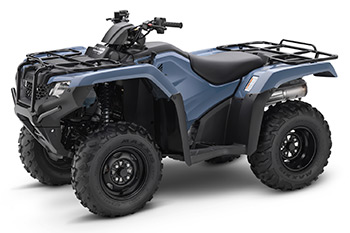
Honda’s initial announcement of the 2017 powersports model year involves a number of ATV products, including the highly popular Rancher lineup, the large-displacement Rincon, the versatile Recon and the sporty TRX250X. For 2017, several of these models are refreshed with new color options.

“ATVs remain an important product category for us, so weÂ’re pleased to kick off the 2017 powersports model year by announcing the Rancher, Rincon, Recon and TRX250X,” said Lee Edmunds, Manager of Motorcycle Marketing Communications at American Honda. “With these great 2017 models, we expect to maintain our position as the number-one ATV manufacturer.”

Rancher2017 Honda Rancher

With incredible versatility and value, the Rancher has been a strong performer since its 2000 introduction, helping it to become the best-selling ATV in Honda’s history. The current version is the best ever, enabling customers to choose between Independent Rear Suspension (IRS) or swingarm, Automatic Dual Clutch Transmission (DCT) or standard gearbox, Electric Power Steering (EPS) and standard, and 4×4 or two-wheel drive. No matter what the options, Ranchers are renowned for their durability, and theyÂ’re equally capable at the jobsite and on the trail. For 2017, two new colors have been added—Black for the 4×4 Automatic IRS EPS and Shale Blue for the 4×4 Automatic EPS.

Colors:
Rancher, Rancher 4×4 Automatic DCT IRS: Red, Olive
Rancher 4×4 Automatic DCT IRS EPS: Black, Honda Phantom Camo
Rancher 4×4, Rancher 4×4 ES: Red, Olive, Honda Phantom Camo
Rancher 4×4 Automatic DCT EPS: Shale Blue, Red, Olive, Honda Phantom Camo
Base Price: $5,299 US
Availability: June 2016

Rincon2017 Honda Rincon

For customers who prefer larger ATVs, the Rincon is the biggest model in HondaÂ’s lineup, with a powerful 675cc liquid-cooled, fuel-injected four-stroke engine and premium long-travel suspension, giving it unmatched comfort and ride quality. Since its 2003 introduction, this top-of-the-line model has been an ATV industry trailblazer, currently with fully Independent Rear Suspension (IRS), radial tires and an automotive-style, beltless three-speed automatic transmission that can also be shifted manually. For 2017, the Rincon is available in a new Black color option, in addition to Red and Honda Phantom Camo.

Colors: Black, Red, Honda Phantom Camo
Base Price: $9,299 US
Availability: June 2016

Recon2017 Honda Recon

Proving that good things sometimes come in small packages, HondaÂ’s nimble Recon can work circles around many larger utility ATVs. The modelÂ’s light weight and small footprint make it easy to maneuver through tight situations, and the longitudinal, 250-class engine still has plenty of power and torque for getting the job done or making it through challenging terrain. Electric start and Rincon-like styling are both standard. The Recon is available in two configurations: one with Electric Shift Program technology (ESP) and one with a manual-shift transmission.

Colors: Red, Green
Base Price: $4,049 US
Availability: July 2016

TRX250X2017 Honda TRX250X

Introduced in 1987, the TRX250X remains a big hit with sport riders, who appreciate its wide powerband, high fun factor and legendary Honda reliability. New riders love HondaÂ’s exclusive SportClutchâ„¢, which allows them to learn clutch control without having to worry about stalling. At the same time, long-travel suspension means the TRX250X is appropriate for advanced riders as well. For 2017, the standard white version gets a new silver wheel color.

Colors
TRX250X: White
TRX250XD: Special Edition Red/White
Base Price: $4,699 US
Availability: May 2016

Different jobs, terrain, and adventures mean it only makes sense to fine-tune your Honda ATV to your specific needs. A full line of Honda accessories is available to make your ATV even better.

American Honda Motor Co., Inc., is the sole distributor of Honda motorcycles, scooters, ATVs and Side-by-Sides in the U.S. American HondaÂ’s Motorcycle Division conducts the sales, marketing and operational activities for these products through independent authorized Honda retail dealers.

For more information on Honda products, go to powersports.honda.com.

THE TEST RIDE PROCESS

0

My job is to wade through all the marketing and sales noise and help the average guy or gal buy the vehicle that will best suit his or her needs.

This is why I really like attending trade shows, talking to readers and viewers, going on group rides or just riding with people who don’t ride off-road for a living. Riding with you helps keep me grounded and helps me understand what your wants and needs really are.

So to do my job well, I have to take myself out of my own situation and put myself into yours. I have to ask and answer the right questions… the ones you’re asking. I have to remember the average buyer hasn’t ever peeked behind the industry’s curtain to know what’s coming in the future or what technology is on the horizon.

So, when I write or shoot a test ride segment on a new vehicle I try to look at it through the eyes of a consumer.

I ask: What features on that vehicle will be appealing, or what will a potential buyer want to know about it most? What aspects of this vehicle will either please or frustrate someone who might own it for many years? What is this vehicle intended to do? If a buyer were to believe the sales and marketing hype, would they be pleased or disappointed with their purchase? If a person were to spend their money on this vehicle, would they feel like they got their money’s worth?

I also try to keep in mind that not everyone wants, needs or can afford the biggest and baddest ATV or SxS in the brochure. As a consumer, it’s not smart to be spending money on vehicle that’s either way more or way less than you need it to be.

Sure, ego plays a large role here and the word “need” has lost most of its meaning these days. But if you’re looking for an ATV to go in and out of the hunt camp, trail ride on weekends and get some work done around the yard here and there, I really shouldn’t be suggesting you buy a Sportsman 1000.

A great example of this comes from the SxS industry right now. Much of the media attention is focused on 110-plus-horsepower vehicles with 18-inches of travel and $5000 shock packages. These are impressive pieces but the reality is they are the wrong choice for the majority of buyers because they are simply too big and too powerful.

If the average trail riding SxS driver were to ask me what they should be looking at, I would have to put my ego aside and start by recommending a 50 or 60-inch model. Both are less powerful than their top of the line counterparts, so my recommendation might not be as much fun… but that rider would be getting a vehicle much better suited to his needs.

At the end of the day, my job is to be an anti-salesman. It’s not about up-selling, it’s not about having the most features or the biggest engine. It’s about enjoying the ride, turning the key each morning with a smile on your face knowing yours is the perfect vehicle for you. If that’s the case, I did my job well.

2016 Yamaha YXZ1000R SE Ride Impressions

0

Luke is shredding the dunes in Glammis aboard Yamaha’s all-new and highly anticipated YXZ1000R SE featuring a 3-cylinder 998cc engine churning out an impressive 115 horsepower and an industry-first sequential shifting manual transmission.

Then Luke provides his opinions of the YXZ1000R pointing out exactly what he likes and what you may not like about this vehicle after getting a YXZ1000R on our home turf and spending some time out at our top secret test track.


Subscribe to our YouTube Channel!

Visions Of Victory – Episode 3 – Mint 400

The S3 Power Sports / Can-Am Race Team takes on the legendary Mint 400 to defender their championship title that they won in 2015.


Subscribe to our YouTube Channel!

CAN-AM RACER EARNS HISTORIC DOUBLE VICTORY

Can-Am X-Team racer Cody Miller made history at the inaugural Camp Coker Bullet Grand National Cross Country race in Society Hill, S.C., becoming the first racer to win a 4×4 Pro ATV class and the XC1 Pro UTV class on the same day. Miller was also joined by Can-Am X-Team teammates on the UTV overall and class podiums, giving Can-Am a sweep.

“Cody Miller was outstanding in South Carolina, winning both premier GNCC Pro classes he entered and making the morning and UTV overall podiums,” said Jeff Leclerc, Racing Project Leader, Can-Am. “Miller has matured as a racer and it’s nice to see him continue to make huge strides toward winning both championships this year in his first full season of GNCC racing. Kevin Cunningham, Tim Farr and Steve Matko each made their respective class podiums as well in South Carolina, so it was a good weekend for Can-Am.”

Miller (Can-Am / DWT / Houser Racing / Elka Suspension / HMF) is the now the clear GNCC XC1 Pro UTV class points leader after three rounds of side-by-side racing and his most recent victory. The Texas racer has now won two events, including the opener in Florida, and been on the podium at all three UTV rounds. Tim Farr (JB Racing / Can-Am / Houser Racing / Maxxis) and Steve Matko (Offroad Motorsports / WickedBilt / Can-Am) joined Miller on the XC1 Pro UTV class podium, giving Can-Am the sweep.

“What a weekend! All year, I’ve been dreaming of bringing home a first place in both the 4×4 Pro and the XC1 Pro SxS classes,” said Miller. “I was finally able to make that dream a reality at the Camp Cocker Bullet GNCC, marking my name down in the history books as the first one to put down a double win in these two Pro classes. With its large motocross section and lots of fast fields, this new property showcased the speed, power and handling of both my Can-Am Outlander XT-P and Maverick X ds 1000R vehicles. I’m on a mission to bring home two championships in 2017, but still have work to do.”

Fourth-place in the XC1 Pro UTV class went to Mouse Pratt (JackÂ’s Excavating / Can-Am), while reigning two-time XC1 Pro UTV class champion Kyle Chaney took 11th place. Despite the finish, Chaney remains second in the points race heading into the next UTV race. Can-Am Maverick racer Dave Plavi won the XC2 Pro Sport class in his Off-Road Motorsports / WickedBilt / Can-Am to extend his points lead, while another JackÂ’s Excavating / Can-Am pilot, Joe Krcelich, finished third.

In ATV action, Can-Am ATV racers recorded three class wins and 11 total podiums in South Carolina. Miller notched his first 4×4 Pro class win of the season aboard his Can-Am Outlander XT-P and was followed across the finish line by Can-Am Renegade Pro racer Kevin Cunningham (Cunningham Racing / Can-Am). The two Can-Am riders diced back and forth during the final three laps, but it was Miller who came out on top. Three Can-Am racers are currently in the top five in points after five rounds of ATV racing. Cunningham leads in points, while Jordan Phillips, who won round three, and Miller are tied with 86 total points.

GNCC ATV racing resumes May 14-15 in Indiana, while side-by-side vehicles return to action May 28-29 in Ohio.

BRP (TSX:DOO) is a global leader in the design, development, manufacturing, distribution and marketing of powersports vehicles and propulsion systems. Its portfolio includes Ski-Doo and Lynx snowmobiles, Sea-Doo watercraft, Can-Am all-terrain and side-by-side vehicles, Can-Am Spyder roadsters, Evinrude and Rotax marine propulsion systems as well as Rotax engines for karts, motorcycles and recreational aircraft. BRP supports its line of products with a dedicated parts, accessories and clothing business. With annual sales of over CA$3.8 billion from over 100 countries, the Company employs approximately 7,900 people worldwide.

brp.com

CAN-AM OUTLANDER MAX 450L

0

Pressure on ATV sales from the burgeoning SxS market is intense. Check out the price of a Ranger or RZR at the low end and it’s not hard to see why more and more ATV buyers are opting for a SxS. This isn’t a trend anymore; it’s more like a landslide.

With this reality bearing on the ATV market, the need for high value, competitively priced ATVs is paramount. Clearly, the best way to sell more ATVs in the face of the SxS revolution is to make sure lower priced models deliver exceptional value.

It’s taken quite a while, however, we’re convinced the arrival of the “L” series of Can-Am’s successfully crosses the price-value bridge. The company has wisely responded to a legion of dealers literally begging for competitively priced models.

In the past, Can-Am refused to make excuses for its comparatively steep asking prices. With the arrival of the “L” series, Can-Am is packing a powerful punch in what is rapidly becoming the meat of the market again: The 450-550 4×4 Sport-Utility segment.

The new 450 Rotax 4-valve single powering this new Max Outlander is impressive. The engine is exceptionally torquey but it can rev-out nicely, too, when held wide open. It delivers a near-60 mph (100kmh) top end. The best part of the engine’s personality is its trail-willing throttle response. You can drive this 450 aggressively on twisty trails with the throttle. The rear wheels will spin and slide around tight turns with little more than throttle massaging as a result of copious low-end power.

Maybe you’re wondering if a 450 Outlander Max can be any fun with two on board? You bet it can! In fact, this long wheelbase ride made no excuses the entire time we were wringing it out with either one or two aboard. The engine has ample torque to pull steep grades and long WOT (wide open throttle) pulls on fire roads. It does so with snappy, responsive power at both ends of the RPM range.

What are you not getting with an Outlander L? Not that much. This particular one came with the optional DPS (Digital Power Steering) package including nice cast aluminum wheels. It didn’t have the handguards and bush bars an XT comes with and it uses a downscaled digital gauge package. The racks are steel without any composite covering and it uses a conventional key, not the DESS electronic encoded key. That’s the stuff it doesn’t have, and honestly, we didn’t miss the upscale goodies at all.

When it comes to what the “L” does deliver in the face of stiff industry competition, the tally is impressive. There’s a premium Visco-Lok differential, selectable 4×4, single lever disc brakes with braided steel hoses, a hitch receiver, nice backrest, Can-Am’s stout CVT with a hi-low range sub tranny, winch pre-wiring, and it’s all built on the Can-Am G2 chassis with revised twin trailing arm geometry and double A-arm IFS.

Unless you want to spend more money – solely because you’ve got more money – we see no one missing the 450 in XT clothes. Fact is, “L” is the only way you get a 450 in either Max or standard length. The overall build quality is extremely good. There’s a tight, solid feel to this ATV and you’ll experience this tangible quality the moment you fire up its 450 Rotax.

We could only generate one gripe with the 450 and it was consistently harped on. The sub-tranny shifter for hi/lo/reverse is a reluctant device when shuttling from forward to reverse in tight situations. The lever requires herculean force to move and everyone agreed it feels like you’re bending something while you apply Incredible Hulk bicep force to the lever. We know Can-Am can do better.

This all-new ATV is entering a white-hot marketplace dominated by the Polaris off-road juggernaut. Putting the “L” on the ATV industry’s most intense battlefield could be risky for Can-Am. On the other hand it could be the vehicle that finally gives Polaris an honest run for its money.

Yamaha San Bernardino National Forest Initiative

Yamaha Motor Corp., USA, employees returned to the San Bernardino National Forest this past weekend to volunteer their time in support of projects aiding the popular Summit OHV Staging Area.

Working with members of the Southern California Mountains Foundation (SCMF) and the U.S. Forest Service (USFS), the effort represented the eighth year of Yamaha Outdoor Access Initiative volunteer projects in one of the nation’s busiest forests.

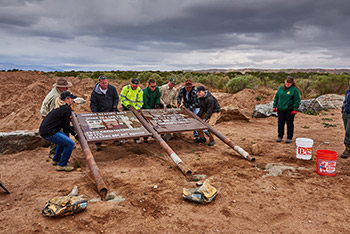
More than 60 volunteers including Yamaha employees, their friends and family members, along with members of local Girl and Cub Scout troops, contributed more than 200 hours of volunteer service throughout the weekend. Activities included installing signs and kiosks, watering and planting native seedlings, and helping general restoration and rehabilitation of the staging area and surrounding trails.

“Yamaha is proud to continue its longstanding working relationship with the Southern California Mountains Foundation and U.S. Forest Service as we create models for productive private-public collaboration with the shared goal of increasing safe, responsible access to popular public off-road riding areas,” said Steve Nessl, Yamaha’s ATV/SxS group marketing manager. “The Yamaha Outdoor Access Initiative is dedicated to those who work and play outdoors. This commitment includes financial investments through quarterly Yamaha OAI grants, as well as the hands-on loyalty from our passionate employees.”

Yamaha volunteers have participated in eight restoration projects within the San Bernardino National Forest. Past work includes projects in and around the Pinnacles, Cactus Flats, Big Pine Flats and Coxey Meadows areas, planting more than 4,000 native seedlings and restoring and maintaining the OHV trails and trailheads.

“Yamaha is a valued partner of the Southern California Mountains Foundation helping to support our OHV program and many of the 2.4 million visitors who come to enjoy the mountains each year,” said Stacy Gorin, Southern California Mountains Foundation executive officer. “In all their years of support for the program, Yamaha volunteers made a positive, significant impact on the San Bernardino National Forest, completing projects from the Big Bear area to across the mountains at the Summit Staging Area.”

For more information on the Yamaha Outdoor Access Initiative, or to submit a grant application for similar projects, visit yamahaoai.com.

2016 POLARIS SPORTSMAN ACE 900

0

Why is Polaris pushing so hard with the all-new, ACE concept? Clearly this question needs an answer. In three short model years the company has expanded this groundbreaking vehicle’s profile from one low powered version to three, each with increasing power levels.

Here’s what we think. It’s no secret something is going on with ATV (4 wheeler) sales and it’s not good. The past five years North American sales of traditional ATVs has continued to slump. At the same time this traceable decline has been playing out, the sale of SxS vehicles has continued to grow. Perhaps skyrocket would be a better word. It’s clear, herds of ATV buyers are converting to side-x-sides.

We wonder if the ACE a result of Polaris’ careful analysis of the stratospheric rise in the popularity of side-x-sides? Is the popularity of the ACE rooted in its SxS ergonomic package? Do ATV riders want off-road vehicles that are sit in, not sit on?

Okay, don’t panic just yet. However, we’re beginning to believe the off-road market is going to end up looking more like the SxS market than the ATV market in the future. The ATV as we know it is likely going to continue to plateau in sales and popularity, however, we think off-road buyers as a whole will not decline in number. Simply put, their purchase preferences are changing to vehicles that are easier to operate, more comfortable, require less physical effort, less skill and are inherently safer.

Read that last sentence again and ask yourself if any OEM wouldnÂ’t be thinking about an ACE-type vehicle with all of these attributes entrenched in the “one-by-side” ACE. The truth is, if any ATV manufacturer isn’t playing in the SxS biz, the writing may be on the wall. In the future it’s possible the ACE archetype may become the new Polaris ATV. Hence, the ACE is actually labeled the “Sportsman ACE”.

Polaris is notorious for responding to the market with lightning speed. Once the first ACE 330 hit the ground and off-roaders and Polaris dealers got an understanding of the vehicle’s capability, Polaris landed the 570 ACE.

This ACE variant immediately rang the bell here at Dirt Trax World HQ. The ACE platform loved the extra jam from the 45-hp 570cc ProStar single and the chassis was fully able to take advantage of more power. Trail riding (driving?) immediately made sense in comparison to the original 30-hp, 330cc ACE, which was light on power, and a little sedentary on a trail ride, though still fun.

Now, the more powerful 570 could be throttle steered, wheelied over logs and powerslides were just plain fun. It all made sense. The ACE could deliver ATV-caliber fun in an almost SxS package that was easier to drive, safer for the occupant and just as capable as an ATV in off-road terrain.

The Pro Star 900cc, 8-valve DOHC mill out back is a twin. That means the entire experience is smoother, the throttle more responsive and the power more linear. If powersliding the 570 is fun (and it is) getting sideways with the 900 is ridiculously more so.

Polaris has wisely chosen to equip the 900 ACE with a front anti-sway bar. The other two ACE models use only rear sway bars. However, the 900’s wheel spinning potential means the chassis regularly gets full-lock-sideways when you’re goofing around. The anti-sway bar brings a dose of understeer – or push – to the front end as it limits roll onto the outside front wheel in turns. This leveling makes the vehicle easier to control in a powerslide as the outside front wheel produces less bite while you saw at the wheel.

Will you sense the understeer? Sometimes. When turning the 900 off-throttle it feels a little soft on initial turn-in. However taking the edge off the 900 ACE front end is a good idea. It keeps the vehicle more stable when you get too sideways.

The 900’s extra jam makes navigating gnarly trails easy. Rocks, logs and stuff requiring body-english and deft throttle control on an ATV come down to a simple stab at the accelerator peddle. The nose lifts, the ACE carries its front end as the rear wheels pop over the obstacle.

Maybe you’ve never ridden your ATV like that. With the ACE, you will. Polaris’ proven AWD system works precisely the way it always has on a jillion Sportsman ATVs. For the most part, it’s transparent when engaged but highly effective when all four wheels are needed to pull you through deep chocolate or up a slippery slope.

We’ve found few limitations riding an ACE compared to a regular ATV – save one. Because you’re seated very low in the chassis, fording streams can leave your butt wet. The secret to the ACE’s predictable handling and stability lies in its radically lowered center of gravity (lower engine, lower rider).

Compared to a conventional Sportsman ATV the driving position is lowered by feet, not inches. Thus the low seating position will leave you more vulnerable to water and mud intrusion. Polaris has identified an answer to this issue but leaves it up to buyers to add (unless they buy a premium upgraded ACE model). ItÂ’s the inclusion of complete doors. With the full door package installed gripes with water and mud intrusion pretty much go away.

In the future, the question most prospective ATV buyers will ultimately ask themselves is whether they’re an ACE buyer, an ATV buyer or a SxS buyer. All three offer a unique off-road experience and all three have distinct advantages. Our advice, after going through this exact mind-meld ourselves is this: Make sure you get a test ride in an ACE before you make your next off-road vehicle purchase.

WINCHING 101

0

It recently came to my attention that perhaps not everyone understands the processes involved in winching your ATV or SXS out of a mud hole.

After thinking about it, I realized there are a few tricks someone newer to the sport, or someone who hasn’t pushed their limits in the mud, may not know about.

So, here is a basic step-by-step “how to” on winching.

Step one: Realization

Once you’re in this deep there’s no avoiding it, you’re GOING to get muddy. Just jump into that murky quagmire and let the adventure REALLY begin.

Step two: Assessment

Often you can get a vehicle un-stuck without a winch if you take a minute to analyze the situation. Why aren’t you moving? Are you hung up on something? Is there any way you can move enough to get traction?

Remember, backing out of a mud hole is NOT admitting defeat. Sometimes it’s your best option to get another run at it.

Step three: Acceptance

If you’ve accepted you’re not going to wiggle out of this one, it’s time to thinking about HOW you’re going to winch out.

Start asking yourself, should you pull forwards or backwards? Where do you attach the winch cable or where should you park the vehicle winching you out? Can you get to a solid winch point on the frame of your ATV?

Once you’re done the math, it’s time to get dirty.

Step four: Attachment

If you donÂ’t know the basics of using your winch, you’re not alone. If nobody ever showed me, I wouldn’t know either.

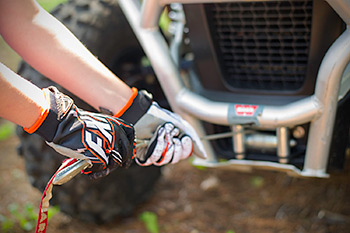
All winches have a free wheel lever. This detaches the cable spool from the internal gears of the winch so you can pull the cable out by hand. It’s usually on the side and it can often be hard to get to. Your best to figure out where it is BEFORE you leave so your not hunting for it underwater.

Once you’ve released the spool, pull the cable out as much as you need. Usually just enough to reach the stuck bike or winch point with a little extra so you can wrap it around something solid.

Remember, you’re pulling HARD on your stuck ATV so whatever you wrap your winch cable around needs to be TOUGH.

Wrapping the cable around a suspension part or bumper could cause damage to the vehicle. If it’s available, the trailer hitch is usually the best option.

Some ATVs don’t have winch friendly hitches so find a solid frame member to wrap the cable around. If possible, wrap it around more than one frame member.

Step five: Accept Help

Now it’s time to start winching. First, ensure your ATV is in 4-wheel drive with diff lock engaged (if available). If youÂ’re winching from your own vehicle you still need to use the throttle to help. Keep your helmet and goggles ON, just in case something goes wrong with the winch cable.

You want to run the winch in stages and feather the throttle as you’re pulling. The idea is not to pull the ATV ALL the way out of the mud hole. Just get you to a point where the vehicle will drive out on its own.

If someone is pulling you out, keep you lid and goggles on and help the process by keeping the tires rotating. When you do finally gain traction don’t throttle out like crazy or you’ll run over the winch cable. Just slowly crawl back until the winch operator tells you to stop.

Step six: Appreciation

Time to either say a quiet prayer of thanks for the winch you have OR say a loud “THANKS” to the guy who helped you. The rules of the trail state that you now owe them one. Also take a moment to stand back and appreciate how awesome it is that an ATV can get that stuck, then unstuck and still finish the ride.

Finally, appreciate that without the winch, you’d still be in that hole so if you don’t have one, grab your phone and place an order right there on the trail. Apparently you NEED it.

Other notables:

* Most ATVs have a reverse override switch. You must push and HOLD this button to get 4X4 and/or full throttle in reverse. If you don’t push it, your throttle will be limited and 4X4 may not engage.
* Jerking a vehicle out of a sticky situation is hard on your winch. It tends to bind the cable on the spool and can make it harder to unwind the cable next time you need it.
* Putting the winching vehicle in reverse can help steady it as you’re pulling on another ATV. Try to avoid throttling it in reverse while your pulling.
* Never wind up a loose winch cable. Keep a bit of tension on it when retracting it to avoid tangles on the spool.
* Try winching from different angles if straight forward or backward isn’t working. All you’re trying to do is get some traction. There may not be any in a straight line.
* If you’re being winched and something goes wrong you start tipping or rolling unexpectedly, have an exit strategy.