Home Blog Page 282

NEW SEASON OF DIRT TRAX DRAWS NEAR

From the Executive Producers that bring you SnowTrax Television, Supertrax International Magazine and Dirt Trax Magazine comes the highly anticipated new season of Dirt Trax Television premiering the week of June 25th on the Outdoor Channel across the USA and OLN and WildTV in Canada.

With six successful seasons of programming, unquestionable growth in viewer numbers and awards received for Best Off-Road Show and Best Videography and Camerawork; Dirt Trax Television continues to answer the demands of ATV and Side-X-Side enthusiasts across North America.

Hosted by Luke, AJ and Mark Lester each episode of Dirt Trax Television is meticulously produced, expertly filmed and ultimately in a league of its own. Dirt Trax Television has become the “must watch” television series for North American ATV and Side-X-Side enthusiasts.

Spanning 26 episodes from June to December, the new season of Dirt Trax promises to be the best yet. Fans can expect to see the latest in-depth reviews of ATVs and Side-X-Sides, destination segments comprised of spectacular scenery, plus in-shop technical upgrades and maintenance features, along with human interest stories from the exciting world of off-road adventure.

Dirt Trax Television is sponsored by Arctic Cat, Bling Star, Can-Am, Camoplast, GBC Motorsports, Go Pro, Hatfield McCoy Trails, Honda, HCR Racing, Moose Racing, Moose Utilities, Parts Unlimited, Polaris Off-Road Vehicles, Scott Sports, Slick Off Road Wash, Steadymate, Triton Trailer, Yamaha and Z1R Helmets.

Visit dirttraxtv.com for showtimes and to watch full episodes online. Join us on Facebook to stay connected with us!
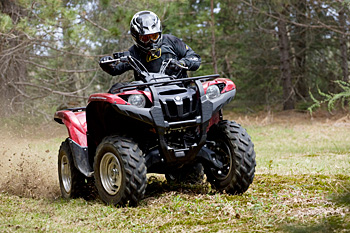
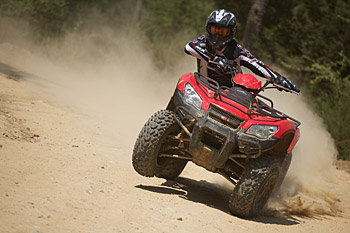
HIGH COST OF TECHNOLOGY

We heard some ATV owners griping the other day about how the price of ATVs has skyrocketed the last few years.

It’s true, the average cost of a 4-wheeler has been climbing steadily the last ten years and when you examine the prices year by year, the price increases do seem a bit arbitrary.

The point is, if you were buying exactly the same thing every year, $300 to $500 increases would seem like a rip-off, especially over a 5-year period.

However, the consumer market has put the OEMs in a precarious place where the demand for technology requires millions of dollars worth of investment to get sales.

If you compare a 10-year-old ATV to what is in the showroom today, you’d see incredible differences. Independent suspension, very advanced 4WD systems, electronic fuel injection, digital gauge packages, automatic transmissions with engine braking and power steering are all modern advancements that cost real money. These have all become must-haves to gain consumer approval.

Here’s the point: When an OEM adds expensive electronic or mechanical tech to its model lineup, the investment in that technology is spread out over the life of the vehicle.

In other words, if EFI is added to a model, the company does not expect to recoup that investment in one single year. Usually the recoup is spread over 3-5 years and may include a whole series of models being sold.

Tech is expensive and that’s why ATVs aren’t cheap anymore.

WHAT’S BETTER? Horsepower or Price?

A question we’ve often asked each other around our well-lit Dirt Trax garage, is whether buyers look for horsepower more than low prices when choosing an ATV.

Certainly, big power gets all the headlines and is what makes potential buyers’ spines tingle. However, given the nature of ATV use, does the whole purchase decision get skewed when it comes down to getting the biggest blast for your dollar?

A fine example is the incredible success of the Polaris 500HO Classic. This is probably the largest selling single model in the whole ATV business. Why? If you compare its utility (basically, the way it works), its ride and its features and then mix in its torquey power delivery from a relatively primitive, carbureted powerplant, you can see why the masses gravitate to it when itÂ’s time to write the check.

Another successful model series is Arctic Cat’s downsized new 350 and 425 4×4 series. These are very strong selling models that don’t offer big displacement mills or mind-bending power, but are full-featured ATVs priced at the bargain level.

On the other hand, the sizzle goes to the big-inch, mega-torque 700, 800 and bigger models that have huge price tags but are guaranteed to deliver more thrills per cubic centimeter. Having these influential “flagships” at the top of any OEM’s model list seems to carry enthusiasm downward into their lower priced offerings.

One thing is for sure. ATV buyers won’t buy an ATV with a reputation for being totally punched, no matter how low the price is. What they will buy is an ATV priced low because it’s missing a few features but still delivering decent performance.

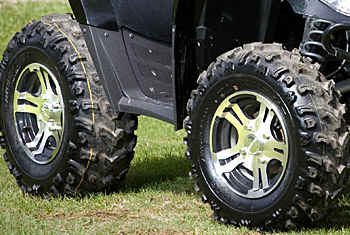
What Good Is 4WD If Your Tires Are Lousy?

Honestly, we’ve talked to hundreds of ATV and UTV owners who have absolutely no clue what to look for when choosing tires.

Frequently, the tires that come with your new ATV aren’t anything more than bare minimum, low-tech donuts destined for a short lifespan.

It’s one sure-fire way for a manufacturer to shave some cost on the MSRP of a wheeler and, unfortunately, it’s false economy. Not all new ATVs fall into this trap but if you own one that has skimped-out on rubber, you will simply never get the most from your off-road vehicle with cheap tires on it.

Here are some things to look for:

Ply rating:

Generally, the more plies the tire has, the longer it will last and the stiffer the sidewall will be. A balance is needed here, particularly with mud tires.

The sidewalls need to have enough “give” to conform to the turf and provide bump absorption, but also need to be stiff enough they don’t get gouged by rocks and stumps or worse cut the sidewall against the rim on impact.

Rubber durometer:

This is actually the grade or texture of the rubber the manufacturer is using in the tire. If the durometer is way soft, you can rip and tear the lugs or simply grind the tread away on hard surfaces.

If it’s too hard, the tire will be slick and slippery on hard, wet surfaces and won’t allow the sidewalls to flex enough to provide good ride characteristics.

Tread pattern and placement:

Oftentimes aftermarket buyers purchase tires that merely look good and don’t serve the riding style the owner has. If you’re riding on gnarly rock surfaces, you need a tire with a tread pattern that wraps around the sidewall a bit so you can bite the granite when you’re wedged somewhere.

If you ride mud a lot, you need widely spaced lugs that will clean-out quickly but with enough lug depth you can get a grip on terra-firma even when submerged. There are a ton of different tread configurations available and you should do some research before you buy.

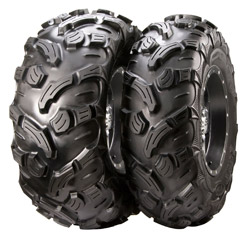
ITP 900XCT TIRE

The all-new ITP 900XCT is engineered and manufactured in the U.S.A. to accommodate the unique demands of side-by-side UTVs.

It features a rugged 6-ply-rated radial carcass and a unique, directional tread design that promotes predictable, well-balanced handling characteristics.

Its radial construction provides plush ride qualities, which are further enhanced by a tread pattern that supplies an ideal level of grip while remaining quiet and smooth on a variety of terrain surfaces.

The ITP 900XCT is now in stock and ready for immediate delivery to a powersports dealer near you in two sizes: a 27x9R-12 front (P/N 560572) and a 27x11R-12 rear (P/N 560573).

Since 1982, ITP has grown into the world’s #1 ATV/UTV aftermarket tire and wheel source, and continues to provide a complete line of innovative tires and wheels for virtually all ATVs and UTVs. For a copy of ITPÂ’s full-color product catalog, call toll-free: 1-800-859-4740. For other inquiries or technical advice, contact ITP at 930-A S. Rockefeller Ave., Ontario, CA 91761; (909) 390-1905. Or visit ITP’s website at www.itptires.com

CREAMER WINS FIRST NEATV-MX PRO-CLASS OVERALL

Motoworks / Can-Am racer Josh Creamer earned his first ATV Pro-class overall aboard the Can-Am DS 450 at round four of the New England ATV Motocross Series held this past weekend at Capeway Rovers Motocross Park in Carver, Mass. Creamer, who recorded a 2-1 moto finish on the weekend, was joined on the podium by BCS Performance / Can-Am rider Cody Miller.

“Josh put in a pair of excellent rides this weekend and earned his first Pro-class overall for team Motoworks / Can-Am,” said Jimmie O’Dell, Race Manager, Can-Am. “This was a well-deserved victory for Josh and Can-Am, as we remain in the chase for another professional ATV motocross title. Both Josh and Cody had impressive moto performances aboard their Can-Am DS 450 machines, once again showcasing the machineÂ’s elite capabilities.”

Despite heavy rain, muddy conditions and nagging injuries, Creamer was in championship form at round four of the NEATV-MX Series. The first Pro-class moto began with Miller edging Creamer for the holeshot.

The two Can-Am-mounted racers put in a great battle throughout the moto, but slick, muddy conditions created minimal passing opportunities and the two riders finished the race how they started it. The moto victory was the first in 2011 for Miller, who is the reigning NEATV-MX Pro champion.

In the second Pro-class moto, Creamer took charge from the start as he grabbed the holeshot aboard his Motoworks / Can-Am DS 450. Creamer, the 2010 AMA ATV MX Champion, pulled away and took an easy victory in moto two. His 2-1 moto scores were good for the overall and more than made up for not reaching the pro podium the previous round. Creamer is now just 17 points out of first place heading into round five.

“We had a good weekend and I am really glad to finally take a win,” explained Creamer. “I hope the rest of the season goes as well as this round, so I can take over the points lead and give Can-Am a championship.”

Miller paired his first-moto win with a fourth-place ride in the second pro moto. He got pushed out on the start and was in last place off the line. However, the young Texan put his head down and passed his way into fourth place before crossing the finish line. His 1-4 moto finishes were good for third place overall and a fourth-consecutive trip to the Pro-class podium. Miller sits comfortably in third place, 19 points behind Creamer with four rounds completed.

“I got a great start in the first pro moto. Creamer was right behind me, but I held him off and was able to take the win,” said Cody Miller. “It felt good to win that moto and I am happy to again be on the podium.”

For more information on Can-Am racing, the entire 2011 schedule, the 2011 contingency program and Can-Am DS 450 ATV amateur racer support program, please visit www.can-amxteam.com.

TRACK KIT QUESTIONS

Dear Motorhead:

I thoroughly enjoyed your review on the Camoplast 4S track system on Dirt Trax Television. I have been considering this exact kit for my 2007 AC 650 H1 with 3.6 rear diff’s or a new Mudpro with 4.0 gears.

Question 1) I believe that the AC does not offer a mounting kit for tracks for the Mudpro. The comment from the dealers is that the 4.0 gearing is too low. Apparently adding tracks will lower your gearing by 30%. Can you elaborate on this – Is the Mudpro geared too low for tracks?

Comment: The only obstacle that you did not attempt in your ride review was to cross a log across a trail. I have ridden with tracked ATVs before and a log crossing (6-inch dia or bigger) is virtually impossible. Any tracked ATV riding in areas with a lot of felled (wind-blown) trees needs to carry a good chainsaw.

Once the log is between the front and rear track, you are stuck. The front track can easily start the climb but the rear tracks tends to slide under the log. Then backing up, the front track also slides under the log.

Did you experience during your testing?

Much appreciated. Look forward to your reply.

Arvo

Thanks for your question!

I find this very interesting as this is EXACTLY what we experienced. A track kit is great until you get hung up on a log, which we did on about 4 separate occasions during our testing.

We actually found we had to build small log ramps in front of the log after the front wheels went over to help get the rear tracks to climb.

It seems to me simply adding an approach angle on the rear tracks would solve this problem – not as extreme as the front, but some sort of upturn would help and we did contact camoplast about this suggestion.

Tracks will definitely gear your ATV down at least 30%. Our Sportsman XP is capable of 70mph with wheels, but probably around 40-45 with tracks. However, it handles great at those speeds, which was surprise.

The MudPro is geared low to begin with and will therefore be even slower with tracks, but its certainly not incapable of handling the track kit.

It will fit with a standard AC mount kit. It will be slow on top end, but will deliver excellent torque. Keep in mind, the tracks will stress your drive shafts even more than the MudPro tires do so you may end up having a problem in that area in the future (we have had issues with Cat’s drive shafts on the MudPro and on 700 H1 with tracks).

Other that this issue an Arctic Cat is actually a pretty good choice for a track kit as they sit pretty high and have good bottom end torque.

I hope this info is helpful.

Luke Lester
Dirt Trax Television

Polaris 850 2-Up Touring Passenger Seat Set-Up

Dear Motorhead:

I purchased a Polaris 850 XP Touring partially because of your review on ride quality. While the ride is excellent on fire roads and smoother trails, it suffers on holes or stones.

The front tire hits the obstacle and hardly effects the ride of the ATV. Then the back tire hits it and the whole ATV is moved. This is especially tiresome to the passenger. Do you have a remedy for this? Did you notice this with your riding?

Thanks,

Dave

Thanks for your email!

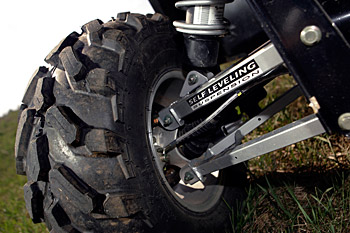
What you are dealing with is shock preload. You need to set-up the rear of the ATV to accommodate a small amount of sag or “ride-in” when you and a passenger are seated.

If you allow too much sag – more than about 5-6 inches from static unloaded ride height – the vehicle will feel harsh on bigger bumps and holes. Try about three inches of sag from unloaded static to loaded ride height.

When you are riding solo – to get maximum ride quality – you may have to re-adjust the preload to provide the best ride. That’s why those snail cam collars are on the rear shocks – if you use them to your advantage you’ll get a better ride.

Hope this helps!

Motorhead Mark

Arctic Cat Parking Brake Concern

Dear Motorhead:

I am looking at an Arctic Cat TRV 550 and I see it does not have “park” in the transmission. My concern is a fluid leak and the parking brake not holding. Should I rely on just the parking brake?

Thanks,

RC

Thanks for your email!

I wouldn’t have any concerns over the hydraulic parking brake. We have never found any AC locking master cylinder system to be anything but highly effective. AC uses steel braided brake lines which are very effective and do not “relax”. That’s our recommendation.

Thanks,

Motorhead Mark

The Trials of Loading an ATV

One of the biggest mistakes utility users make is overloading the cargo bed or racks on an ATV or SxS.

Every mass-production off-road vehicle with any kind of utility-targeted use has a maximum load rating.

Most riders tend to disregard these numbers or complain they’re simply too low to be practical.

Here’s why the OEMs set these ratings the way they do. On an ATV with racks, the front rating is designed to allow the owner to load the rack to its recommended capacity without having difficulty turning the handlebars in either 2WD or 4×4.

When the front racks are loaded, the springs are compressed, there’s less suspension travel and when the vehicle is off-camber or off-center, handling can be difficult, particularly if the front hubs are engaged with power going to them.

The rear capacity is another thing. If you overload either the rack or cargo bed at the back, the front end gets incredibly light and every time you hit a bump, the front wheels want to lift or float.

Not only does this provide way less front traction but steering is so light, the vehicle won’t respond and, instead, plows through corners with terrible understeer.

Both Arctic Cat (Prowler HDX) and Polaris (Ranger HD) have air suspended utility rear shock setups that can compensate for extra weight at the back . Can-Am uses something like this on some of its 2-up ATVs.

Overload both ends of an ATV and, although you will have a better weight balance than front or rear loading only, steering effort becomes very heavy and the vehicle gets severely top-heavy. This makes handling burdensome, and worse… dangerous.